
Business moats in the age of AI
Hi there
Is AI a threat to your business, or is your business the threat to itself?
In my checkins with peers in different industries, it's schocking how different companies respond to this current paradigm shift. Some leaders are pushing themselves ultra hard to adopt AI into their products, upping their own skill set. Big companies even consider evaluating employees on token usage as a proxy metric for 'AI proffeciency' (about as meaningful as lines of code indicating engineering quality). And others are just getting co-pilot rolled out, hardly touching AI at all. That gap makes me think: either you disrupt your own business, or someone else disrupts it for you, unless your business moat is strong enought that you get to decide.
So today we're going to talk about business moats:
- how different business moats hold up against AI
- how to think about your business exposure
- how to apply the same thinking to your career (aka career moat)
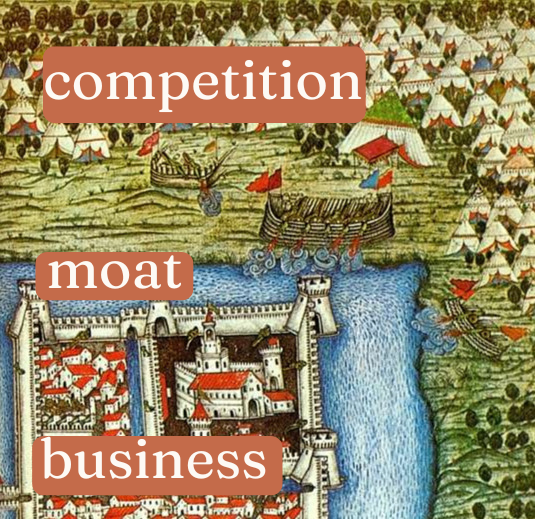
Let's dive in and make sure you are not surprised about the competition your business will be facing.
3 links to get your ideation around moats going
- Last weeks newsletter on the three stages of AI adoption
- Career moats - a long read on how career advantages get build (written pre-AI) https://commoncog.com/a-personal-history-of-the-career-moat/
- https://www.reddit.com/r/ValueInvesting/comments/1pu9qbk/greatest_business_moats_in_history_present/ solid brainstorming session from the good people of reddit

The five types of moats and how they stand against AI
The question is simple: if you are not disrupting your own business, how exposed are you to someone else doing it instead?
As a product leader this framework has helped me anticipate where my business is heading, and position my strategy for the future emerging and not the present moment. It's also great to assess if I still believe in the overall trajectory of the company, and if I can't change it, I've quite (which was the right move 😎)
Here are five moat types, in roughly ascending order of durability against AI.
Brand/marketing moats
What it is: customers choose you because they know and trust the name, not because the product is uniquely better
How AI changes it: content creation and distribution are getting very cheap, very fast. AI-native competitors are getting good at both. What's less obvious is that distribution now also means visibility to AI agents, not just human buyers. If you offer a service — say, sending text messages to users — are you a preferred choice for someone wanting to integrate that capability into something they are building with a tool like Lovable? That's the new distribution surface way too few companies are thinking about.
Durability against AI: weak to medium. If your moat is mostly about visibility and top-of-mind awareness, it's getting competed away faster than almost any other type.
Data moats
What it is you own proprietary data that competitors can't replicate, and it makes your product measurably smarter or more accurate.
How AI changes it: the value of data depends heavily on whether public data plus reasoning can get "good enough" for your use case. For some categories, it can. For others i.e medical records, who applied for a loan (and repaid it), what features your users are using, you still have the data and the outcome loop closed inside your product
Durability against AI: medium. Strong if your data is genuinely proprietary and hard to synthesize but weak if the open models keep catching up to what your data used to uniquely enable. (Esp with the models shadily trained on proprietary data!)
Switching cost moats
What it is: leaving you is painful enough (migration, retraining, integrations) that customers stay even when a better option exists.
How AI changes it: this moat has two foundations: customers have generated data with you, and they've built you into their systems and workflows. Both are getting easier to move. Data migration tooling is improving, the EU is pushing hard for users to own and export their data, and retraining an AI agent on a new platform is trivially easy compared to retraining a human team.
Durability against AI: medium, and declining. If switching costs are your primary moat, now is a good time to layer something else on top. (Also it's not very gentlemanly to your users to rely on this moat.)
Network effect moats
What it is: your product gets more valuable with every additional user, so newcomers can't catch up just by being technically better.
How AI changes it: marketplaces, payment networks (Visa/Mastercard, Klarna), and social graphs are still hard to replicate even with sophisticated AI. That said, we have seen social graphs fragment (RIP twitter as it was/fb etc) as users migrate toward platforms with more genuine content and human connection. The big monolithic networks have already peaked. What replaces them is still unclear, but smaller, higher-trust networks may prove more durable than the giants.
Durability against AI: strong, with some nuance depending on category.
Regulatory / trust / licensed moats
What it is: laws, licenses, or certifications mean only a handful of players are even allowed to operate in your market.
How AI changes it: Banking, healthcare, defense, pharma are still operating with the most durable moats, laws and regulations are slow to change. However we do see companies constantly find ways around regulatory barriers. A recent example being Siemend (German) who communicated plans for AI investments worth just over SEK 11 billion, the bulk of which will go to the US. All this to speed up their use of AI, a trend that will effect the EU laws over time.
Durability against AI: strongest of the five, but not invincible.
Questions worth reflecting on
- What moats is your business actually leaning on now?
- If you would recreate your business from scratch, which of your current moats would you prioritise to keep?
- Which of your moats are truly yours and which are inherited from your industry?
- What's the competition doing?
Applying moats-thinking to your career
Everything above is applicable to your own career as well (with a bit of creativity). To get you started, here are some questions to reflect on?
- what parts of your job can be replaced by AI, and which parts not?
- what's the weird/uncommon/unique combination only you bring?
- what are some hard skills to learn that would moat you up for the future?
That's it!
Here's what we talked about today:
- There are three modes: either you disrupt your own business, or someone else does it, or your moats are protecting you from external preassure to change. (or all of the above)
- Not all moats are equal. Brand and switching cost moats are weakening fast. Network effects and regulatory moats are holding up much better.
- Your career has moats too.
Did this resonate with you?
Hit reply with your own thoughts.
/Ylva
PS If you liked todays newsletter, tell a friend!